


TL;DR: Monarch exposes the credit chain behind Anthropic’s $44.6 billion compute commitment: the financing, energy, construction, and equipment needed to make capacity usable. Nscale’s IPO tests whether the infrastructure company can coordinate those steps and whether a signed customer contract can support the capital required to deliver it.
Nscale’s IPO puts Monarch, its planned vertically integrated AI campus in West Virginia, at the center of a question behind Anthropic’s expansion: when a frontier lab commits to future compute, who finances the power, equipment, and construction required to deliver it? The answer will help determine whether contracted demand becomes operating capacity, and where economic risk and value settle along the way.
A year ago, I called compute Anthropic’s single point of failure: the Harness was only as durable as the silicon beneath it, supplied by companies that also had a stake in Anthropic. By May, the access problem had become acute. In “King Claude: The Orchestration Moat in Operation”, I examined Anthropic’s efforts to secure compute at scale. By August 2026, access was no longer the only question; the commitments that addressed it had created a financing challenge of their own. In “The Compute Trap 2.0: How Anthropic Refinanced Its Single Point of Failure”, I followed that shift.
Nscale brings that question to the supplier side. The British company is building an integrated AI infrastructure business spanning sites, power generation, data centers, and GPU capacity. Anthropic has agreed to take compute capacity at Monarch, according to Nscale’s S-1. Nscale’s Monarch materials and acquisition announcement describe the ambition to bring those layers together; the prospectus lets investors assess what it will take to turn that plan into an operating service.
Nscale filed its S-1 for a New York listing on September 18. The filing does not set a share count or offering price, but the Financial Times reported a valuation target of up to $35 billion. That’s more than twice Nscale's $14.6 billion valuation in its March Series C.
Our full institutional report, released today, applies the Durable Growth Moat™ framework to Nscale’s S-1. This companion article examines the supply-side credit chain: how customer commitments support, or fail to support, the financing of power, equipment, and construction. Nscale’s filing shows two different stages. Microsoft’s prepayments and the financing raised against them have supported capacity; Anthropic’s $44.6 billion Monarch commitment still depends on Nscale securing capital and delivering the campus.
The question for investors is how much of that unfinished chain the reported valuation already prices in.
What is Nscale building?
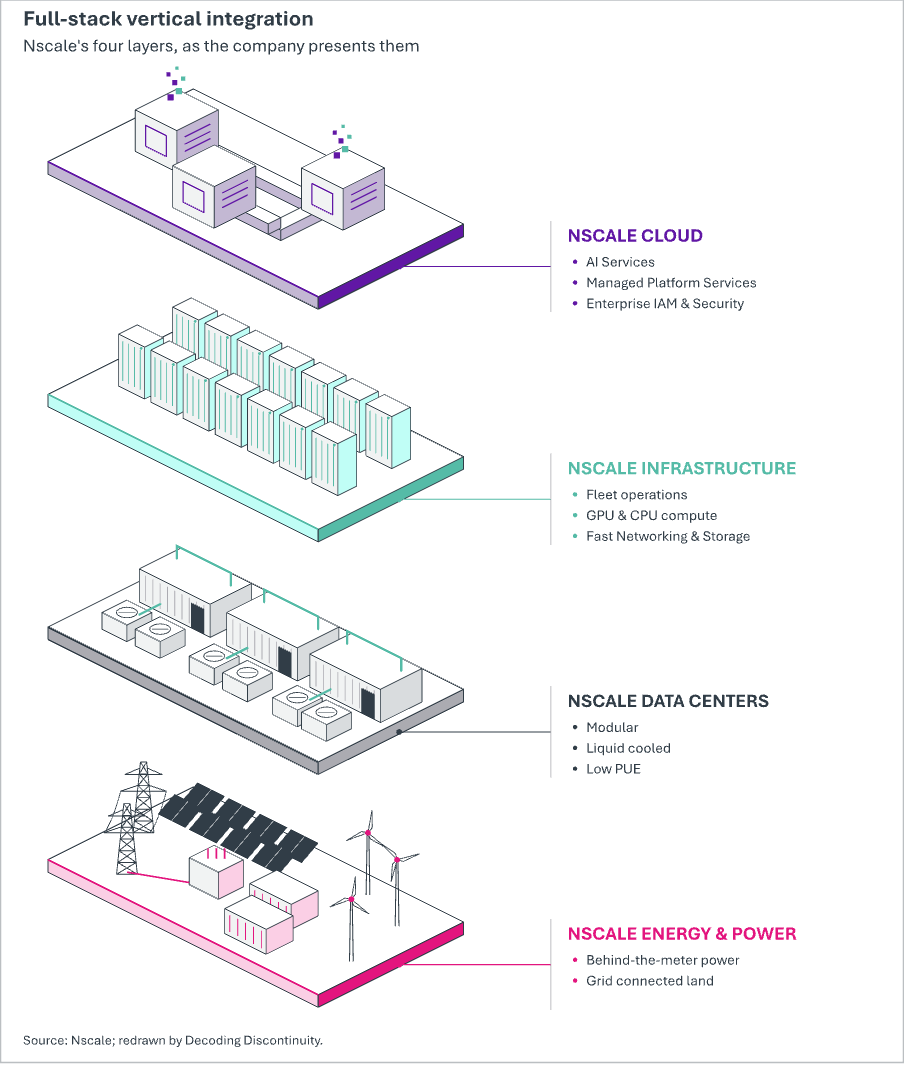
Nscale is building an integrated AI infrastructure business spanning powered sites, generation, data centers and GPU capacity.
The investment case rests on that integration. The British company says it owns every layer of an AI factory, from powered land and behind-the-meter generation to GPUs and the software that runs them. The premise is that one operator can coordinate site development, power, data-center construction, and GPU deployment with fewer handoffs.
That ambition is far ahead of the current operating business. In the first half of 2026, Nscale generated $140.6 million in revenue and recorded a net loss of $1.02 billion. Two customers, Microsoft and Anthropic, account for about 85 percent of its contract book; the largest, unnamed in the filing, was 52 percent of first-half revenue.
The founder’s letter says Nscale has grown from $100 million in total contracted value to more than $103 billion. Microsoft’s statements of work, signed between September 2025 and April 2026, total $43.8 billion through 2033; Anthropic’s four agreements total $44.6 billion.
But only a small share of that book was tied to active capacity as of August 31: $2.6 billion, or about 2.5 percent. Nscale had 55 MW running against 1,370 MW signed, roughly 4 percent; only 7 MW of the running capacity was at sites Nscale owned. It also reported 25,000 active GPUs against 461,000 contracted, about 5.4 percent. The prospectus therefore asks investors to value a much larger pipeline alongside the business Nscale operates today.
Integration could create value by reducing delays across those layers. But it also concentrates capital and execution risk: Nscale still must secure permits, power, financing, and equipment, then deliver capacity customers accept.
Integration helps only if it makes those steps faster, cheaper, or more reliable.
What is the credit chain?
The credit chain is the sequence through which a customer’s commitment supports obligations upstream. The supplier must persuade builders and equipment providers to commit, financiers to fund the work, and the customer to accept the finished capacity. A large contract signals expected demand. It does not prove each step is financeable.
If one link weakens, risk shifts to counterparties, project timing, or the capital needed to keep building.
Nscale’s book shows two different stages.
The Microsoft chain is further along. As of June 30, Nscale reported $6.49 billion in deferred revenue, almost all from Microsoft prepayments. Lenders have also financed GPU facilities in Ward County and North Carolina — $1.85 billion and $1.2 billion, respectively—against Microsoft’s acceptance of delivered capacity. Elsewhere, Nscale’s sites in Norway and Iceland carry project debt, while its Dell framework agreements include $2.54 billion in equipment rent.
These arrangements show how customer commitments, lenders, and equipment providers can each support different parts of an infrastructure build.
The Anthropic chain is less complete. Nscale’s S-1 discloses no comparable prepayment or financing for the Monarch tranches. The contract is signed, but the steps between that commitment and operating capacity remain to be financed and delivered.
Monarch is where the difference between the two chains becomes visible.